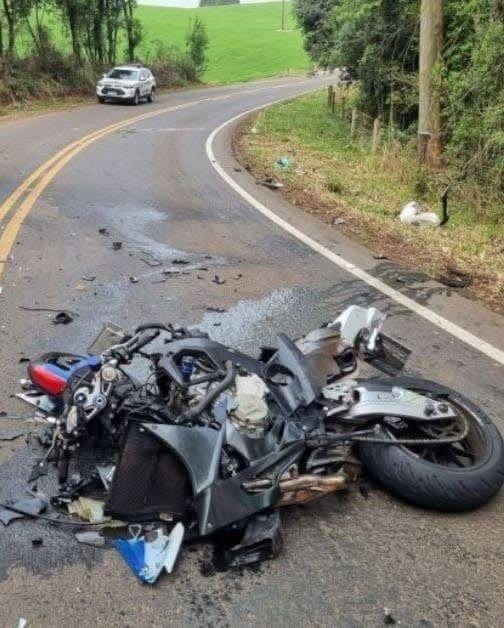
He had everything ahead of him—youth, ambition, and a passion for speed—and yet, it took only one brutal curve to change everything. On a quiet stretch of SC-390, a motorcycle renowned for its power and prestige, a BMW S1000 RR, collided head-on with a modest Renault Sandero. What should have been a peaceful Saturday for two individuals and the communities they belonged to transformed in seconds into a scene of chaos, fear, and irreversible loss. Witnesses froze on the roadside, unsure whether to rush forward or flee, as the screaming sirens of emergency vehicles filled the air, a harsh soundtrack to a tragedy no one on that road would ever forget.
The crash, located in the municipality of Ipira, tore through the calm of Santa Catarina’s Midwest with a force that left both bystanders and residents reeling. The motorcyclist, a 31-year-old man with his whole life ahead of him, had been riding his BMW S1000 RR with the confidence of experience but the vulnerability inherent to such high-powered machines. Approaching a curve that appeared deceptively gentle in the afternoon light, he inadvertently crossed into the opposite lane, meeting a Renault Sandero driven by a 30-year-old woman. The impact was immediate and devastating. The rider was fatally injured at the scene, his life cut short in a violent instant, while the car was left badly damaged, the driver trapped in a state of shock and disbelief, struggling to process what had just occurred.
Military Highway Police officers arrived swiftly, their presence a somber reminder of the realities of road safety. Through careful reconstruction of the scene, they determined that the collision resulted from a combination of factors: a brief invasion of the opposite lane, a misjudged curve, and the merciless speed of a motorcycle capable of accelerating faster than reflexes could respond. The BMW, once a symbol of freedom, status, and exhilaration, had been reduced to twisted metal lying across the asphalt, a testament to the fragility of life at high speed.
Now, the aftermath extends beyond the physical wreckage. The woman driving the Sandero must grapple with the psychological trauma of surviving a collision she could neither anticipate nor avoid. Every glance at the curve that changed two lives evokes memories of sudden terror and helplessness. The community, meanwhile, mourns a young man whose potential, friendships, and ambitions have been abruptly erased. Families, neighbors, and friends gather to console one another, to offer support in small gestures, and to process a grief that feels both immediate and impossible to reconcile.
This tragedy also serves as a stark reminder of the unpredictable dangers of the road. One small lapse in judgment, one miscalculated turn, or one second of overconfidence at high speed can have irreversible consequences, extending far beyond those directly involved. For residents of Ipira and the surrounding region, the SC-390 curve will forever be etched into memory—not as a simple bend in the road, but as a marker of loss, vulnerability, and the fleeting nature of life. As authorities continue their investigation, the wreckage is cleared and traffic resumes, yet the emotional scars linger, a quiet echo of a day that began with the promise of freedom and ended in tragedy.